

PAGCOR caps land-based slot rebates at 1.50% of turnover: what it means in pesos
Short answer — In a notice dated 13 October 2026, PAGCOR told all licensed land-based casinos that slot machine players may now receive rebate incentives worth at most 1.50% of turnover, made up of a cash rebate of no more than 1.40% and a non-cash incentive commission of up to 0.20%. The PAGCOR Board approved the change on 8 October 2026. On ₱100,000 of slot play, that means a ceiling of ₱1,500 in total incentives, of which no more than ₱1,400 can be cash, by our calculation. The same notice keeps the table-game caps at 1.35% of net turnover for non-junket VIP players and 1.50% for junket players.
Why it matters to a Filipino slot player: until this amendment, Regulation 17 of the casino rulebook only described rebate programmes for VIP/high-roller and junket table players. Slot machines now have their own written ceiling, and it sits at the same 1.50% level PAGCOR set for online slot rebates in May. Below we go through what the notice says, what the percentages are worth in pesos, how a rebate compares with the house edge, and what the document leaves open.
What exactly did PAGCOR change on 13 October?
The source is a two-page scanned letter on the PAGCOR regulatory site, titled a Notice of Implementation. It is dated 13 October 2026, addressed "To all licensed land-based casinos" and issued by the Assistant Vice President of PAGCOR's Gaming Licensing and Development Department. It amends Regulation 17 (Casino Player Incentives) of the Casino Regulatory Manual for Licensed Land-Based Casinos, Revision 0, which the letter calls the CRM. We downloaded the file on 24 October 2026; the server reported it as last modified on 14 October 2026.
The letter sets out the old and new wording side by side. Three edits stand out:
- Who may get a rebate. The old Section 1(a) allowed rebate or rolling commission programmes "for its non-junket VIP/high roller and junket players". The new text simply says the licensee "may implement Rebates or Rolling Commission Programs", without naming a player group.
- A new slot machine line. Under a new heading "Slot Machines", the cap is "1.50% of Turnover for Slot Machine Players", comprising a maximum of 1.40% for cash rebate and a remainder of up to 0.20% for incentive commission.
- EGMs added to the GGR rule. Section 3 now says player incentives shall not be declared as gaming table and EGM (electronic gaming machine) losses, and therefore are not a deduction when gross gaming revenue is computed.
The notice says it takes effect "immediately upon publication" on the PAGCOR regulatory site, and that the amendment will be folded into Revision No. 1 of the CRM. It also repeats a rule that already applied to tables: incentive commission "shall not be redeemable to cash".
The news was picked up outside the Philippines too. The trade site SCCG Management reported on 15 October 2026 that the land-based measure follows the online rebate caps set in May, citing GGRAsia. That is a secondary report; every figure in this article is taken from PAGCOR's own documents.
How do the land-based caps compare by player type?
The new table in Regulation 17 now has three lines. One detail is easy to miss: the two parts of each cap cannot both be at their maximum. For slots, 1.40% cash plus 0.20% commission would be 1.60%, which is above the 1.50% total. The word "remainder" in the notice means the incentive commission fills whatever space the cash rebate leaves, up to 0.20%. So an operator could offer 1.40% cash plus 0.10% commission, or 1.30% cash plus 0.20% commission, but not 1.40% plus 0.20%. That reading is ours, based on the arithmetic of the printed caps.
| Player type | Base | Total cap | Max cash rebate | Incentive commission | Mixes allowed (our calculation) |
|---|---|---|---|---|---|
| Slot machine players | Turnover | 1.50% | 1.40% | Up to 0.20% | 1.40% + 0.10%, or 1.30% + 0.20% |
| Non-junket VIP / high roller (tables) | Net turnover | 1.35% | 1.25% | Up to 0.20% | 1.25% + 0.10%, or 1.15% + 0.20% |
| Junket players (tables) | Net turnover | 1.50% | 1.40% | Up to 0.20% | 1.40% + 0.10%, or 1.30% + 0.20% |
Note the base. The table lines speak of "Net Turnover", while the slot line says "Turnover". The notice does not define either term, so we cannot tell you whether a slot rebate is computed on every peso fed into the machine (often called coin-in) or on some netted figure. The examples below assume the cap applies to coin-in, and that is an assumption, not something the letter states.
What is a 1.50% slot rebate worth in pesos?
Turnover is the total of all your bets, not the money you bring. If you sit with ₱5,000 and keep re-betting your wins, your turnover can easily be several times ₱5,000. That is why a small percentage of turnover adds up faster than it sounds. Here is the ceiling at three levels of play, our calculation:
| Slot turnover | Cash rebate at 1.40% | Commission if cash is 1.40% (0.10%) | Commission at full 0.20% (cash 1.30%) | Total ceiling at 1.50% |
|---|---|---|---|---|
| ₱10,000 | ₱140 | ₱10 | ₱20 | ₱150 |
| ₱100,000 | ₱1,400 | ₱100 | ₱200 | ₱1,500 |
| ₱1,000,000 | ₱14,000 | ₱1,000 | ₱2,000 | ₱15,000 |
These are ceilings. The notice does not oblige any casino to offer a slot rebate at all, and a casino may pay less than the cap or attach conditions such as membership tiers. If a casino advertises a slot rebate above 1.40% in cash, the advertisement is worth questioning, because that would exceed the printed cash limit.
Since incentive commission cannot be turned into cash, a player should read it as something like points or credit inside the casino's own programme. The notice gives no list of what counts as incentive commission, so we do not guess at the form it takes.
Does a rebate beat the house edge?
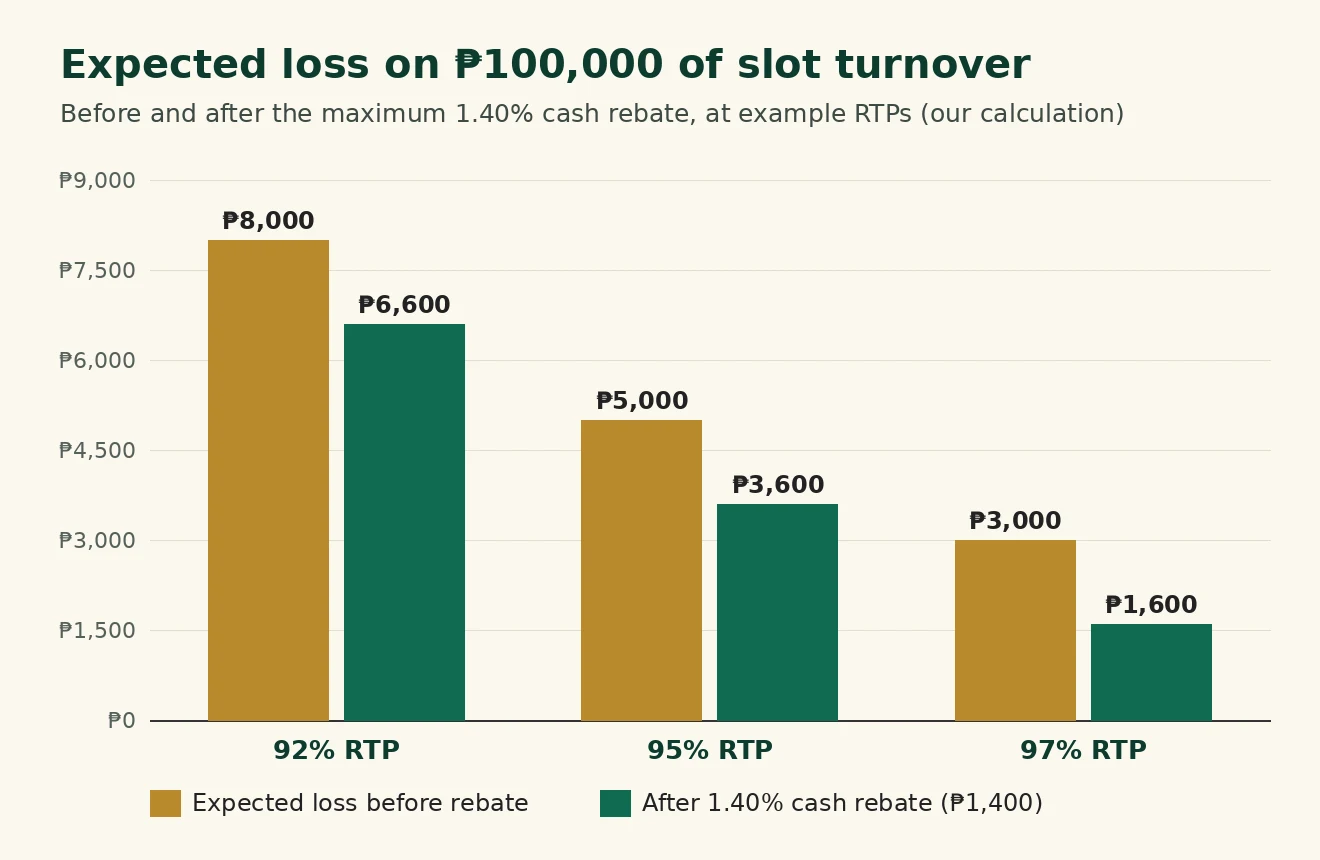
No, not for any ordinary slot. A rebate returns a slice of turnover; the house edge takes a slice of turnover. Whether you come out ahead depends on which slice is bigger. The notice gives no return-to-player (RTP) figure for land-based machines, so we use example RTPs of 92%, 95% and 97% to show the arithmetic. The expected loss is turnover × (100% − RTP). Over a short session your real result will swing far from this average in either direction.
| Example RTP | House edge | Expected loss | After 1.40% cash rebate | After full 1.50% value | Share of loss returned in cash |
|---|---|---|---|---|---|
| 92% | 8% | ₱8,000 | ₱6,600 | ₱6,500 | 17.5% |
| 95% | 5% | ₱5,000 | ₱3,600 | ₱3,500 | 28.0% |
| 97% | 3% | ₱3,000 | ₱1,600 | ₱1,500 | 46.7% |
A slot would need an RTP above 98.5% for the full 1.50% to turn the expected result positive, by our calculation (100% − 1.50%). We know of no evidence that land-based machines in the Philippines are set that high, and the notice says nothing about machine settings.
There is one more trap: a rebate on turnover rewards playing more, and playing more means more expected loss. Take a ₱10,000 budget on a 95% RTP machine. If you re-bet until the budget is gone, the average turnover is ₱10,000 ÷ 5% = ₱200,000, and the maximum 1.40% cash rebate on that would be ₱2,800, by our calculation. You would still be ₱7,200 down on average. The rebate softens a loss; it does not make the session cheaper than not playing.
How does this line up with the online rules from May?
PAGCOR set the online figures in Annex D-1 of the Gaming System Administrators framework, marked "Effective May 07, 2026". It allows a cash rebate based on turnover ("Gross Bets Placed") or deposit of up to 1.50% for slot machine games, electronic bingo, numeric games and sports betting, but not casino table games or arcade-type games. Separately, it allows cashback based on net losses of up to 15% for all types of electronic games.
Annex D-1 adds conditions that are useful for players to know. Each programme must be approved by PAGCOR's electronic games department before it runs, its rules must list tiers, minimum deposit, wagering requirement and any maximum payout, and rebates or cashback "shall not be combined with other promotional cash incentives" in a way that exceeds the maximum rate. Programmes run without approval or above the rate are subject to regulatory action.
Which is worth more on average, 1.50% of turnover or 15% of net losses? They are equal when your loss is exactly 10% of your turnover (1.50 ÷ 15), our calculation. On a game with an RTP above 90%, the expected loss is smaller than that, so a turnover rebate pays more on average. On ₱100,000 of turnover at 95% RTP, the rebate would be ₱1,500 against cashback of ₱750 on the ₱5,000 expected loss. Cashback, however, is only paid when you actually lose, while a turnover rebate is paid whether you win or lose.
| Item | Land-based slots (Reg. 17, Oct 2026) | Online, Annex D-1 (May 2026) |
|---|---|---|
| Rebate base | Turnover | Turnover (gross bets) or deposit |
| Cash rebate cap | 1.40% | 1.50% |
| Non-cash incentive | Up to 0.20%, total 1.50% | Not described |
| Cashback on net losses | Not described | Up to 15% |
| Deductible from GGR? | No | No |
Why does the GGR clause matter to players?
Gross gaming revenue is roughly what a casino keeps from bets after paying winnings. Both documents say a rebate is not a gaming loss and cannot be subtracted when GGR is calculated; Annex D-1 adds that online rebates and cashback must be booked as marketing expenses. In plain terms, a casino pays for a rebate out of its own margin and cannot use it to shrink the revenue figure regulators see. That gives operators a reason to keep rebates modest and conditional, and it is one more reason to read the terms before assuming you will get the cap.
What does the notice not say?
- The meaning of "Turnover" for slots, and why the slot line drops the word "Net" that the table lines use.
- Machine RTPs. Nothing in the notice sets or reports the payout percentage of land-based slots.
- Which casinos run slot rebates. The notice permits programmes; it names no operator, and we have not verified any casino's current offer.
- A transition period. The letter says it is effective immediately on publication. It does not mention how existing slot promotions are to be adjusted.
- The form of incentive commission beyond the rule that it is not redeemable to cash.
What should a player in the Philippines keep in mind?
The PAGCOR responsible gaming page lists persons under 21 years of age among those barred from gaming establishments, along with government officials and employees and people in the National Database of Restricted Persons. The same page links to a self-exclusion request service. If a rebate offer is the reason you are planning a longer session, set the peso budget first and treat the rebate as a small discount on money you have already decided you can lose, never as income.
Sources (checked 24 October 2026): PAGCOR Notice of Implementation, Regulation 17 amendment, 13 October 2026; PAGCOR Annex D-1, Guidelines on Cash Rebate and Cashback Programs, effective 7 May 2026; SCCG Management, 15 October 2026 (secondary report); PAGCOR responsible gaming. All peso amounts, the cash/commission mixes, the RTP examples, the 98.5% break-even and the rebate-versus-cashback comparison are our calculation on the stated assumptions.