

5-Roll match counts: why a missing fixed number blocks a six-number match
In a five-fixed-number construction, every completed six-number line contains the same fixed five. If even one of those five is absent from the drawn set, no changing sixth number can repair the missing match. Counting 37 lines alone does not explain that restriction.
The Lucky777 PH lottery section covers several system constructions. This guide adds a match-count exercise to the existing 5-Roll versus System 7 explanation. All selections and drawn sets below are invented teaching examples.
Define the completed lines before comparing a result
The Game Manual linked from PCSO LottoMatik's downloads page, inspected on 10 October 2026, describes Lotto 6/42 System 5-Roll and lists 37 combinations on printed pages 11–12. We use that six-from-42 construction here without quoting a ticket price or treating a match count as a prize entitlement.
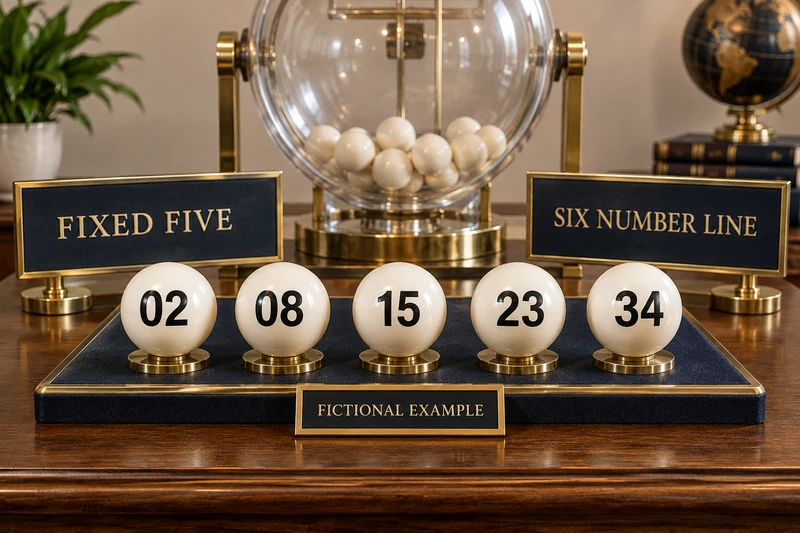
Fix F = {02, 08, 15, 23, 34}. The changing number x can be any of the other 37 numbers from 01 through 42. Each completed line is F plus x. The line with x = 39 is {02, 08, 15, 23, 34, 39}; the line with x = 42 keeps the same five and adds 42.
These are distinct six-number sets for one draw. The changing position does not replace a fixed number, and the order used to display a set does not create another line.
Compare two results that differ by one fixed number
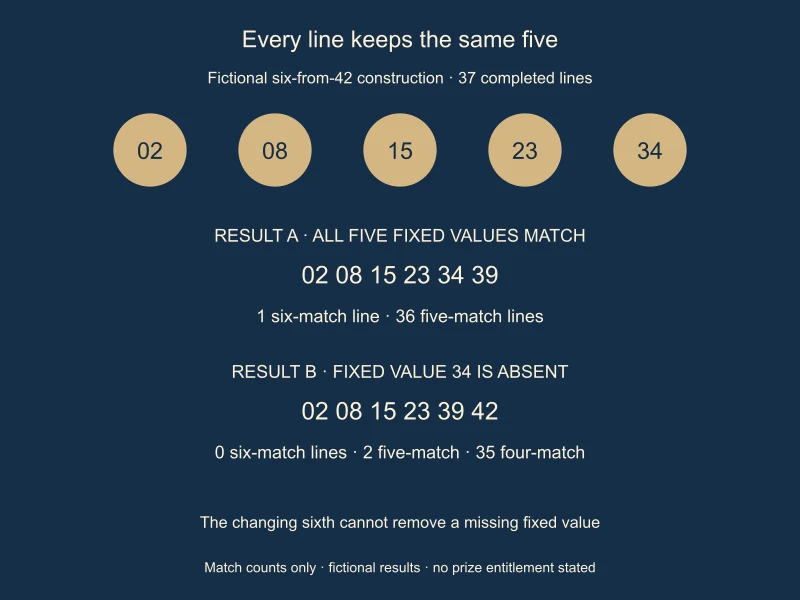
Result A is {02, 08, 15, 23, 34, 39}. All five fixed numbers match. Of the 37 choices for x, only 39 supplies the remaining drawn number. That gives one six-match line and 36 five-match lines.
Result B is {02, 08, 15, 23, 39, 42}. The fixed number 34 is absent. Every completed line still contains 34, so none can equal the six-number result. Choosing x = 39 or x = 42 gives five matches; each of the other 35 choices gives four.
| Fictional result | Fixed matches | Counts across 37 completed lines |
|---|---|---|
| A: 02, 08, 15, 23, 34, 39 | 5 | 1 line with 6 matches; 36 with 5 |
| B: 02, 08, 15, 23, 39, 42 | 4 | 2 lines with 5 matches; 35 with 4; none with 6 |
Use a short formula to check the whole distribution
Let k be the number of fixed values present in the six-number result. Exactly 6 − k drawn values are outside F. Those values are among the 37 possible choices for x.
Therefore, 6 − k completed lines have k + 1 matches. The other 37 − (6 − k) = 31 + k lines have k matches. The two counts always sum to 37.
For k = 5, the formula gives 1 line with 6 matches and 36 with 5. For k = 4, it gives 2 with 5 and 35 with 4. If only three fixed numbers match, it gives 3 with 4 and 34 with 3. These are set-intersection counts; they do not state which categories the product pays.
We enumerated all 37 completed sets for the two results in the table and checked their intersections. The enumeration and formula agree. No assumed randomness is needed for this calculation: it compares given sets, rather than estimating the chance of an unknown future result.
Separate structural coverage from a payment record
A six-match line exists in this construction only when the drawn set contains all five fixed values. That condition explains the shared restriction among the lines. It does not identify which five numbers a person should select, and it does not make the 37 lines independent draws.
The actual product rules still determine accepted entries, eligible prize categories and settlement. In particular, four matching numbers in our arithmetic should not be labelled a paid 5-Roll award without checking the applicable rule. Keep the mathematical count and the confirmed prize record in separate fields.
This restriction also differs from a system formed by all six-number subsets of a larger selected set. The System 8 line-construction guide shows a different boundary: all six drawn values must be inside the selected eight. Do not transfer one construction's conditions to another just because both generate multiple lines.
Check an existing record in the right order
First establish the game, system label and exact draw identity. Then recover the five fixed values and verify that the completed lines follow the stated construction. Compare the result as a set, count fixed matches, and only then examine the applicable prize rules and confirmed settlement.
If the record does not distinguish fixed selections from completed lines, mark that gap rather than inventing a sixth value or assuming a system label. These examples explain a construction; they are not real results, purchase advice, forecasts or a reason to increase spending.